
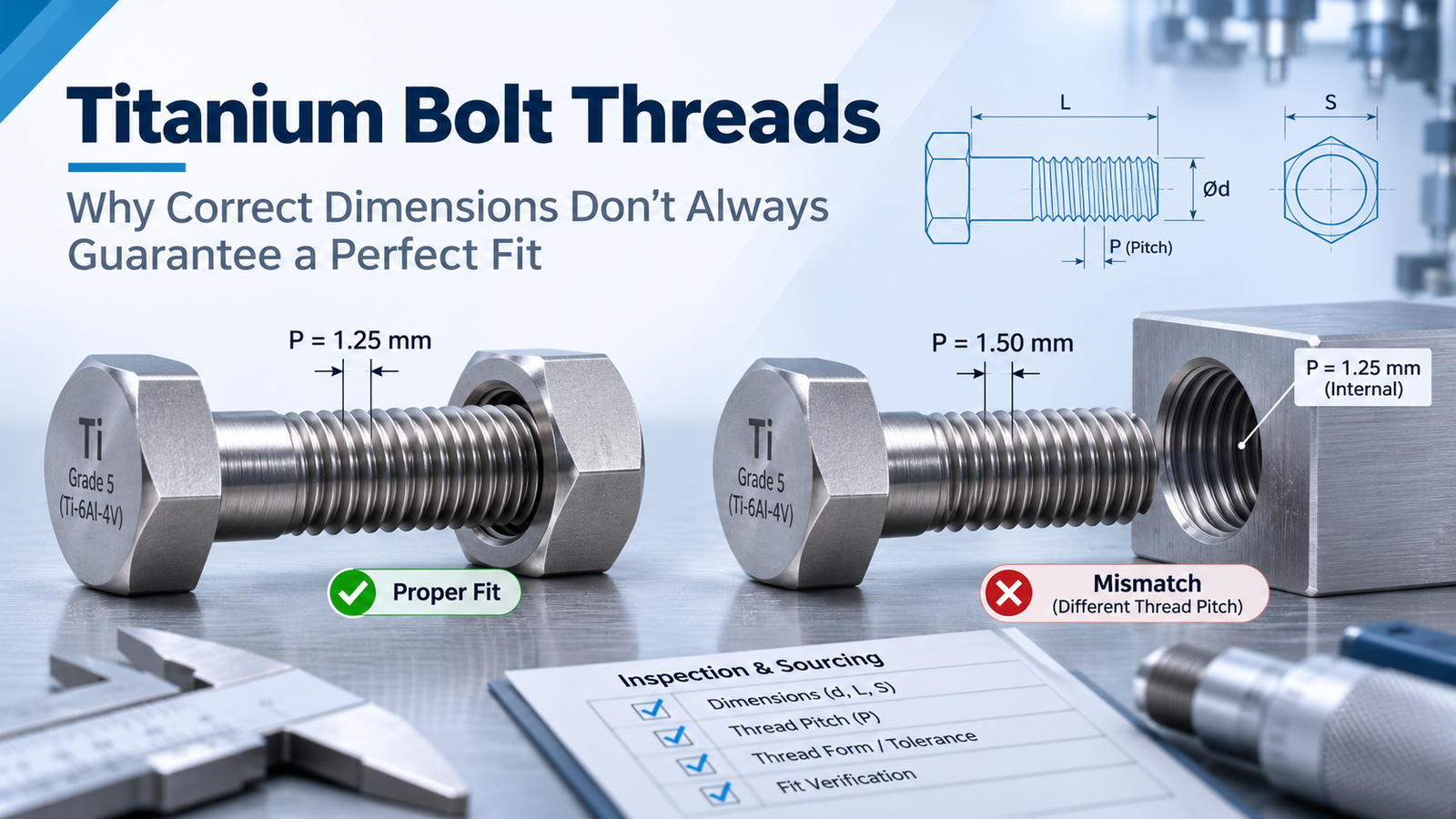
How can a batch of titanium bolts pass dimensional inspection, yet become difficult to install or even seize during assembly?
For buyers sourcing titanium bolt threads with specific dimensional requirements, this can be a frustrating and costly problem.
Imagine receiving several hundred grade 5 titanium bolts that meet your material, color and length requirements, only to discover that some do not fit the intended components smoothly.
For motorcycle parts retailers, bicycle workshops and aftermarket brands, the consequences can go beyond replacing a few bolts. Damaged components, customer complaints and unexpected replacement costs can quickly affect profitability.
The problem may not be the titanium grade itself, but the thread specification, mating conditions or installation requirements that were overlooked during purchasing.
Here are six important details worth checking before placing your next order.
1. Understanding Titanium Bolt Threads Beyond Diameter
When requesting a quotation, buyers often provide the bolt diameter, length, material and quantity. However, thread pitch is another detail that should not be overlooked.
Take M8 titanium bolts as an example:
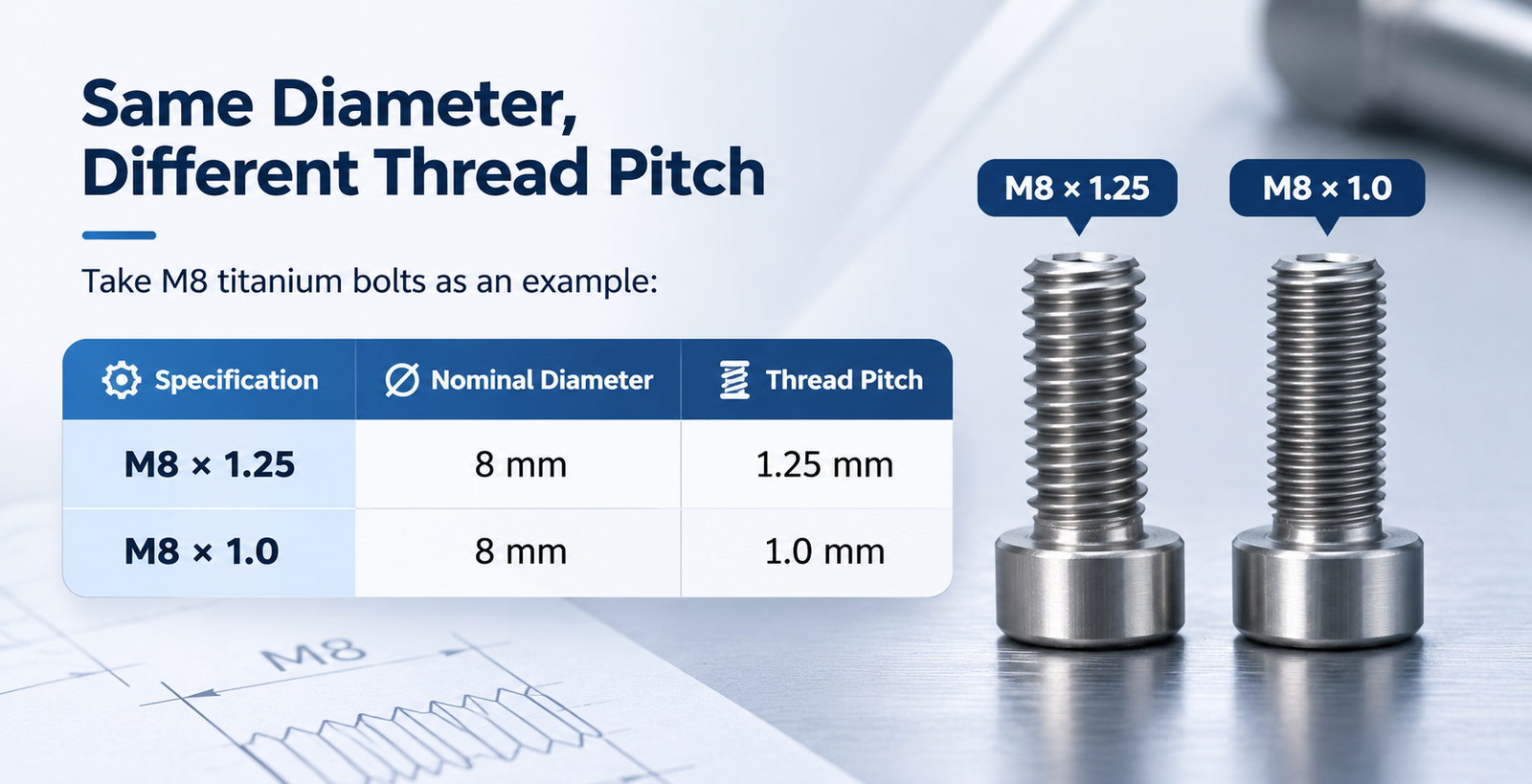
Both have the same nominal diameter, but their thread pitches are different, meaning they require different mating threads.
This is particularly important when sourcing titanium motorcycle bolts for multiple models, where similar-looking fasteners may have different thread requirements.
North American buyers may also encounter metric, UNC and UNF thread systems within the same purchasing project.
Before requesting a quotation, confirm the complete thread designation, effective thread length and mating component requirements.
Providing this information early can help prevent an entire batch from being manufactured to the wrong specification.
2. Why Thread Tolerance Matters When Buying Titanium Bolts and Nuts
Even when two bolts have the same diameter and pitch, their actual thread dimensions may vary within different tolerance limits.
Thread compatibility depends on several factors, including:
- Major diameter
- Pitch diameter
- Minor diameter
- Thread profile
- Specified tolerance class
For general-purpose ISO metric threads, 6g external threads and 6H internal threads are common examples of tolerance classes. The appropriate requirements should always be confirmed according to the drawing and application.
When purchasing titanium bolts and nuts, buyers should not rely solely on whether one bolt can be screwed into one sample nut.
Instead, confirm whether the manufacturer uses suitable GO/NO-GO thread gauges and whether the finished threads meet the agreed specifications.
This is especially important when bolts and mating components are sourced from different suppliers.
A clearly defined thread standard gives both manufacturers and buyers a consistent basis for inspection and acceptance.
3. Why Grade 5 Titanium Bolts Can Still Experience Thread Galling
Grade 5 titanium is valued for its strength-to-weight ratio and corrosion resistance. However, these advantages do not eliminate the possibility of thread galling.
Galling is a form of adhesive wear that can occur when metal surfaces slide against each other under pressure. Material may transfer between the contacting surfaces, damaging the threads and, in severe cases, causing the connection to seize.
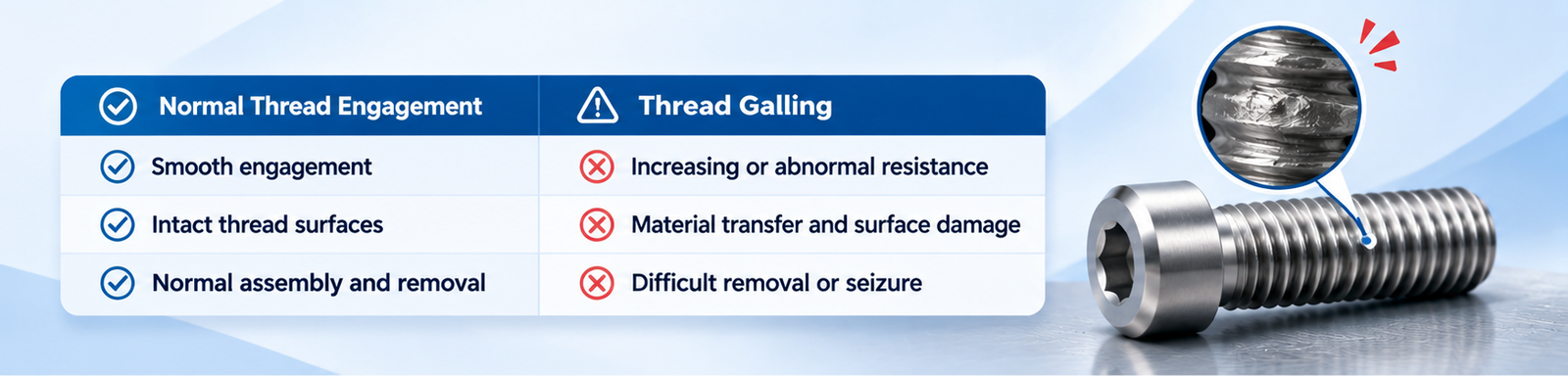
Several factors may increase the risk of galling in titanium bolt threads:
- Unsuitable mating material combinations
- Poor thread surface condition
- Incorrect thread fit
- High contact pressure or rapid installation
- Repeated assembly and disassembly
For businesses selling grade 5 titanium bolts, a seized fastener can become a much more expensive after-sales issue if it damages the customer’s original component.
Material quality is important, but thread compatibility and assembly conditions deserve equal attention.
4. What Buyers Should Consider When Sourcing Titanium Motorcycle Bolts
Motorcycle aftermarket products are often purchased in different sizes, colors and model-specific combinations.
While appearance is an important selling point, the actual installation conditions should also be considered during product development.
For example, friction between the bolt and its mating component can influence both galling risk and the relationship between tightening torque and clamp load.
A suitable anti-seize compound may help reduce galling in appropriate applications. However, lubrication changes friction, so torque values intended for dry threads should not automatically be reused for lubricated threads.
Before ordering titanium motorcycle bolts, discuss the following requirements:
- The material of the mating component
- The required surface finish
- Whether lubrication is appropriate for the application
- Applicable installation and tightening specifications
For safety-critical connections, titanium replacements must be validated against the relevant engineering and original equipment requirements.
For aftermarket brands and retailers, providing appropriate installation guidance can be just as valuable as offering the correct bolt size.
5. How to Inspect Titanium Bolt Threads Before Bulk Production
A sample that looks good and fits one component is a useful starting point, but it does not necessarily demonstrate that every production unit will meet the required standard.
Before approving a bulk order of titanium bolts and nuts, buyers and manufacturers should establish clear inspection requirements.
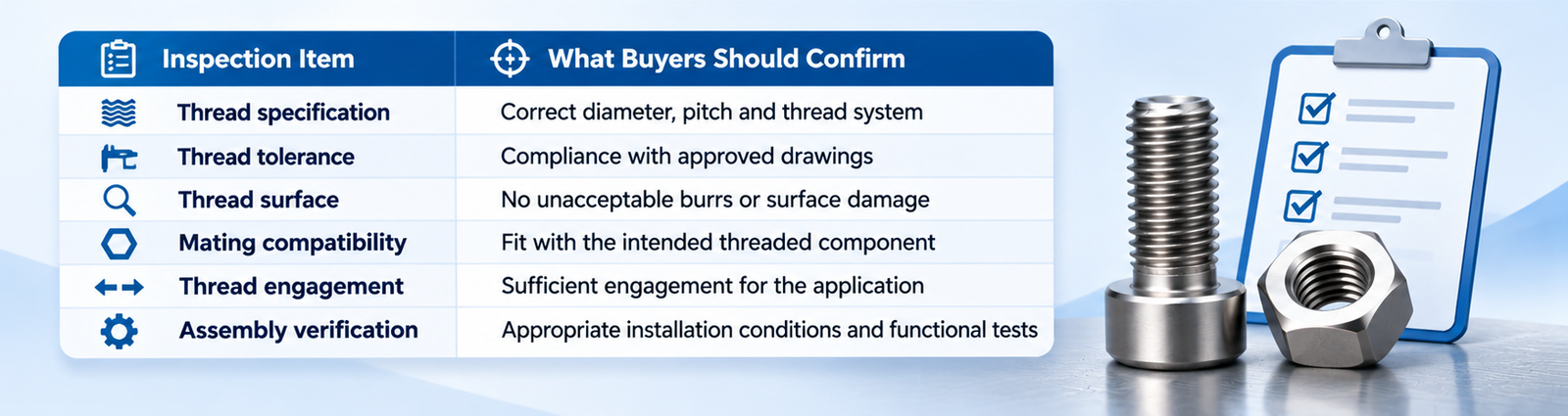
For products designed for repeated assembly and removal, additional application-specific testing may also be necessary.
If unusual resistance or binding occurs during trial installation, stop and investigate the cause rather than forcing the bolt into position.
Keeping approved drawings, reference samples and inspection requirements available for subsequent orders can help reduce uncertainty during repeat purchasing.
6. Better Thread Specifications Begin with Better Supplier Communication
For small and medium-sized aftermarket businesses, one purchasing project may involve standard grade 5 titanium bolts, special thread pitches, different lengths and customized finishes.
The challenge is not simply finding a manufacturer that can produce titanium fasteners, but finding one that understands how the finished components are intended to fit and function.
At RFL Tech, our own manufacturing facility combines CNC precision machining, thread processing and dimensional quality control to support both standard and customized titanium bolts and nuts.
Our manufacturing capabilities include:
- Metric, UNC and UNF thread specifications
- Customized thread lengths, head styles and dimensions
- Standard and non-standard titanium fasteners
- Anodizing, polishing and PVD surface finishes
- Mixed-specification orders with agreed minimum quantities
- Manufacturing based on technical drawings or physical samples
When discussing a new project, sharing the intended application, mating component and thread requirements alongside the basic bolt dimensions allows potential fitment issues to be considered before production.
Whether you are expanding a range of titanium motorcycle bolts or developing a new custom fastener, a more complete specification is often the first step toward a more reliable order.
Final Thoughts
Reliable titanium bolt threads depend on more than the material grade or nominal diameter.
Thread pitch, dimensional tolerance, surface condition, mating compatibility and installation requirements all contribute to the performance of the finished connection.
For businesses sourcing grade 5 titanium bolts, confirming these details before production can help reduce unnecessary sampling, replacement costs and after-sales problems.
Even if you only have an existing bolt, a physical sample or a preliminary drawing, it can provide a useful starting point for discussing the required specifications.
The real cost of a fastener is not just what you pay for it, but what happens when it does not fit.


