
The question we get most from customers is simple: how does the color actually get onto titanium dress up bolts? Honestly, there are only two ways we use in production — PVD coating and anodizing. They look different, they behave differently, and they suit different jobs. Below we go through the strengths of each and the colors you can really get.
1. PVD Coating (Physical Vapor Deposition)
1.1 Hard coating that shrugs off scratches
The coating PVD lays down runs around 2000 to 3000 HV, way harder than the bolt itself. That makes it tough against wear and scratches. If your bolt gets installed and removed a lot, PVD is the safe pick — the surface just won’t pick up marks easily.
1.2 Bonds tight, doesn’t flake
PVD happens in a vacuum, and the coating builds up layer by layer at the atomic level. It locks onto the base metal, so there’s no peeling or flaking in normal use. It also holds up to salt spray and corrosion, which makes it fine for outdoor or damp environments.
1.3 Colors that don’t fade
PVD gives strong, saturated colors. Black, gold, gunmetal — the everyday favorites are all covered. And the color stays put: no fading, no shifting after long use. If your customer cares how a bolt looks, this matters a lot. When you’re shopping for titanium dress up bolts for a build you plan to keep for years, this is where the durable colors live.
1.4 Clean and safe
PVD doesn’t put out heavy metal waste and it meets RoHS requirements. It’s a clean process, and the finished parts are safe to touch. That’s why it works well for glasses, jewelry, and medical gear — things that sit close to skin.
1.5 Colors you can get
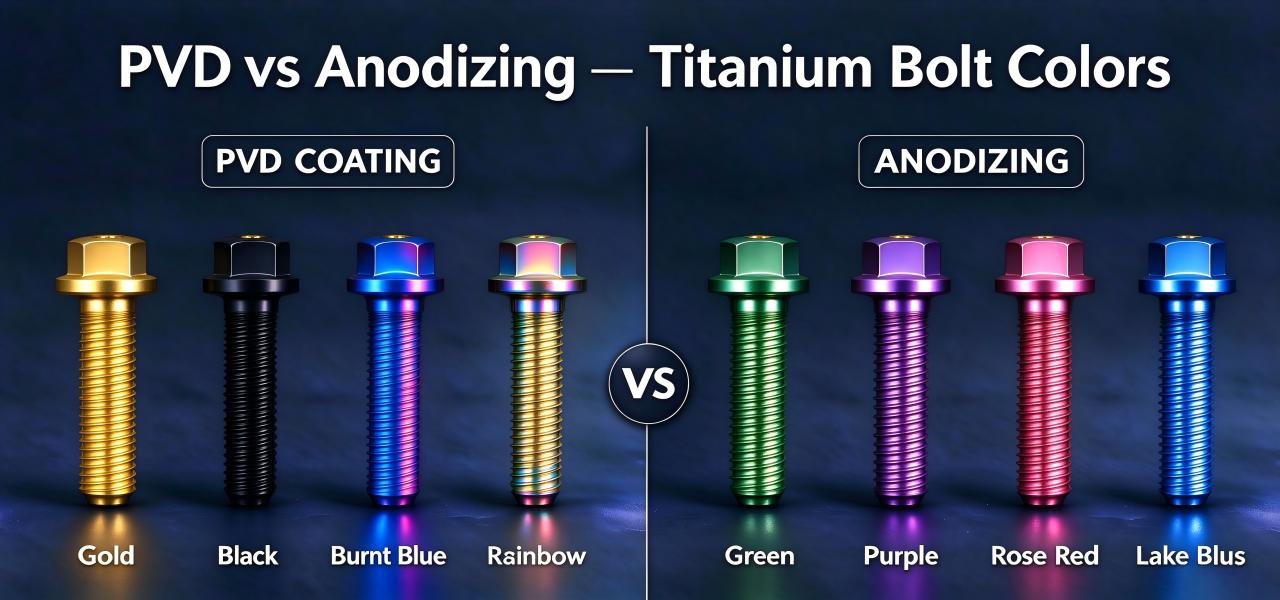
Black, gold, iridescent/rainbow, and burnt blue.
2. Anodizing (Electrochemical Oxidation)
2.1 The color grows out of the metal
Anodizing doesn’t paint anything on. The titanium grows its own oxide layer (TiO₂) on the surface, and the color you see comes from light interference off that layer. It’s part of the bolt itself, so it never peels off.
2.2 Insulating and corrosion-proof
That oxide film is dense. It stands up to acids, alkalis, and seawater. On top of that, it stops galvanic corrosion when titanium sits against a different metal — a real bonus in mixed-material assemblies.
2.3 Low cost, easy to scale
The process is simple and the cost is low. When you’re coloring bolts in big batches, anodizing is hard to beat on price.
2.4 Even colors, tiny batch differences
Color is controlled by voltage, so the shades stay consistent. Batch-to-batch difference stays small, which makes anodizing great for parts that need color coding or matching.
2.5 Colors you can get
Bronze, lake blue, gold, pink-purple, and green. One catch: anodizing can’t do pure black. If you need black, that’s a PVD job.
3. Quick Pick: Which One Fits Your Job?
3.1 Need tough, black, premium? Pick PVD
If the part has to resist scratching, or you want black, or you’re after that high-end look, go with PVD. It won’t let you down — and it’s why most people building dress-up kits reach for titanium dress up bolts in the first place.
3.2 Want low cost, natural titanium, insulation? Pick anodizing
If your priority is price, the natural titanium look, or insulation and corrosion resistance, anodizing is the better fit.
Whether you’re shopping for titanium dress up bolts with bold colors or you just need a clean, functional finish, both routes are covered above. Neither one is “better” across the board — it comes down to your product, the look you need, and what it has to cost. Run through the points and you’ll pick right the first time.


