
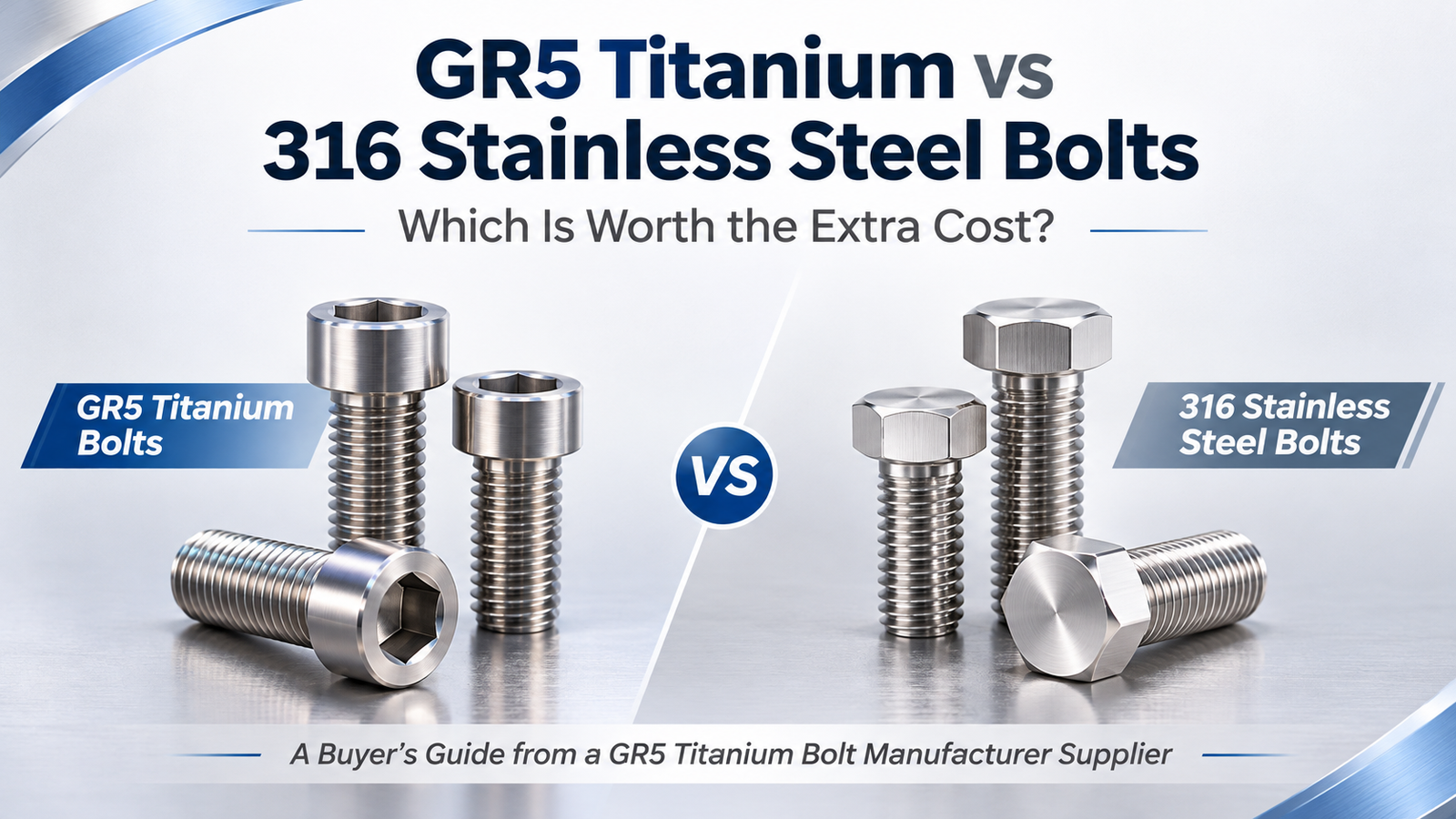
Two bolts can look almost identical, yet carry very different price tags.From the perspective of a gr5 titanium bolt manufacturer supplier, material selection, machining, and finishing requirements can all affect the final cost.
For motorcycle parts retailers, bicycle brands, and custom component buyers, the choice between Grade 5 titanium and 316 stainless steel is not simply about finding the stronger or more expensive material.
The real decision is whether the additional cost of titanium delivers enough value for the product and its intended market.
When searching for a gr5 titanium bolt manufacturer supplier, buyers should look beyond material descriptions and compare actual product performance, manufacturing costs, and long-term purchasing value.
Here are four key areas worth understanding before choosing a material or placing an order.
1. Grade 5 Titanium vs 316 Stainless Steel: What Are You Actually Paying For?
Grade 5 titanium, also known as Ti-6Al-4V or TC4, is widely used for its high strength-to-weight ratio and good corrosion resistance.
316 stainless steel is another popular choice for corrosion-resistant fasteners, particularly where cost and practical durability are important.
Both materials have advantages, but their physical properties and manufacturing costs differ.
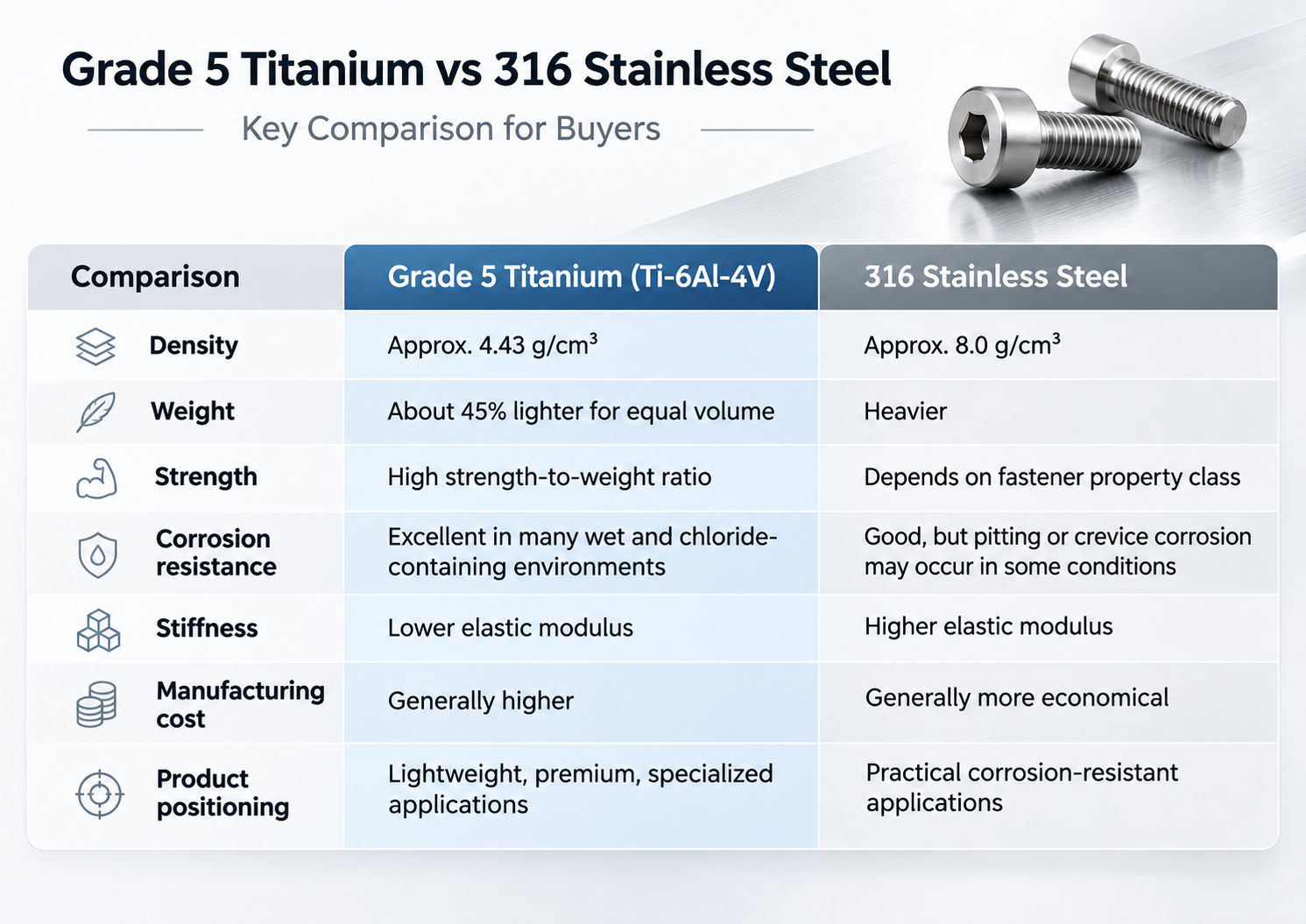
Note: These are general material comparisons. Finished fastener properties depend on the applicable standard, material condition, manufacturing process, and product requirements.
The biggest difference is not always strength.
For bolts of the same size and design, Grade 5 titanium can reduce weight by approximately 45% compared with 316 stainless steel.
This can be attractive for lightweight bicycle components, motorcycle accessories, and premium aftermarket products.
However, strength and stiffness are not the same.
While Grade 5 titanium offers excellent strength relative to its weight, 316 stainless steel has a higher elastic modulus. Stainless fasteners also come in different strength classes, such as A4-70 and A4-80.
For buyers sourcing titanium gr5 bolts, the material grade alone does not guarantee that a particular bolt is suitable for every application.
Our manufacturing advice: Compare the specified mechanical properties and actual product requirements before choosing a material. A higher price does not automatically mean better performance for every application.
2. Which Material Makes More Sense for Motorcycle and Bicycle Parts?
The right material depends on the purpose of the fastener, not just its specifications on paper.
Consider two common purchasing situations.
When 316 Stainless Steel May Be Enough
A motorcycle accessories retailer needs corrosion-resistant bolts for non-safety-critical covers or decorative accessories.
The main requirements are reliable fit, reasonable corrosion resistance, and an affordable selling price.
If 316 stainless steel meets the specified mechanical and environmental requirements, it may offer sufficient performance without the additional cost of titanium.
For a price-sensitive replacement product line, this can be a sensible purchasing decision.
When Grade 5 Titanium Offers More Value
Now consider a bicycle components brand developing a lightweight upgrade kit.
Its customers are willing to pay more for reduced weight, premium finishes, and carefully selected component details.
In this situation, titanium gr5 bolts may provide stronger product differentiation.
Grade 5 titanium also supports a range of decorative surface finishes, making it attractive for selected motorcycle and bicycle customization projects.
However, appearance should never be the only selection criterion.
For brake, steering, suspension, and other safety-critical connections, replacement fasteners must meet the relevant OEM or engineering requirements. Neither titanium nor 316 stainless steel should be treated as a universal replacement for high-strength steel bolts.
Our manufacturing advice: If the product is mainly designed to offer affordable corrosion resistance, 316 stainless steel may be sufficient. If weight reduction and product differentiation are important, Grade 5 titanium may justify the additional investment.
The better choice depends on what your customers actually value.
3. Why Are GR5 Titanium Bolts More Expensive — and Can They Still Be More Profitable?
For buyers comparing suppliers, gr5 titanium bolts price is often one of the first considerations.
But looking at the price per piece does not explain the complete manufacturing cost.
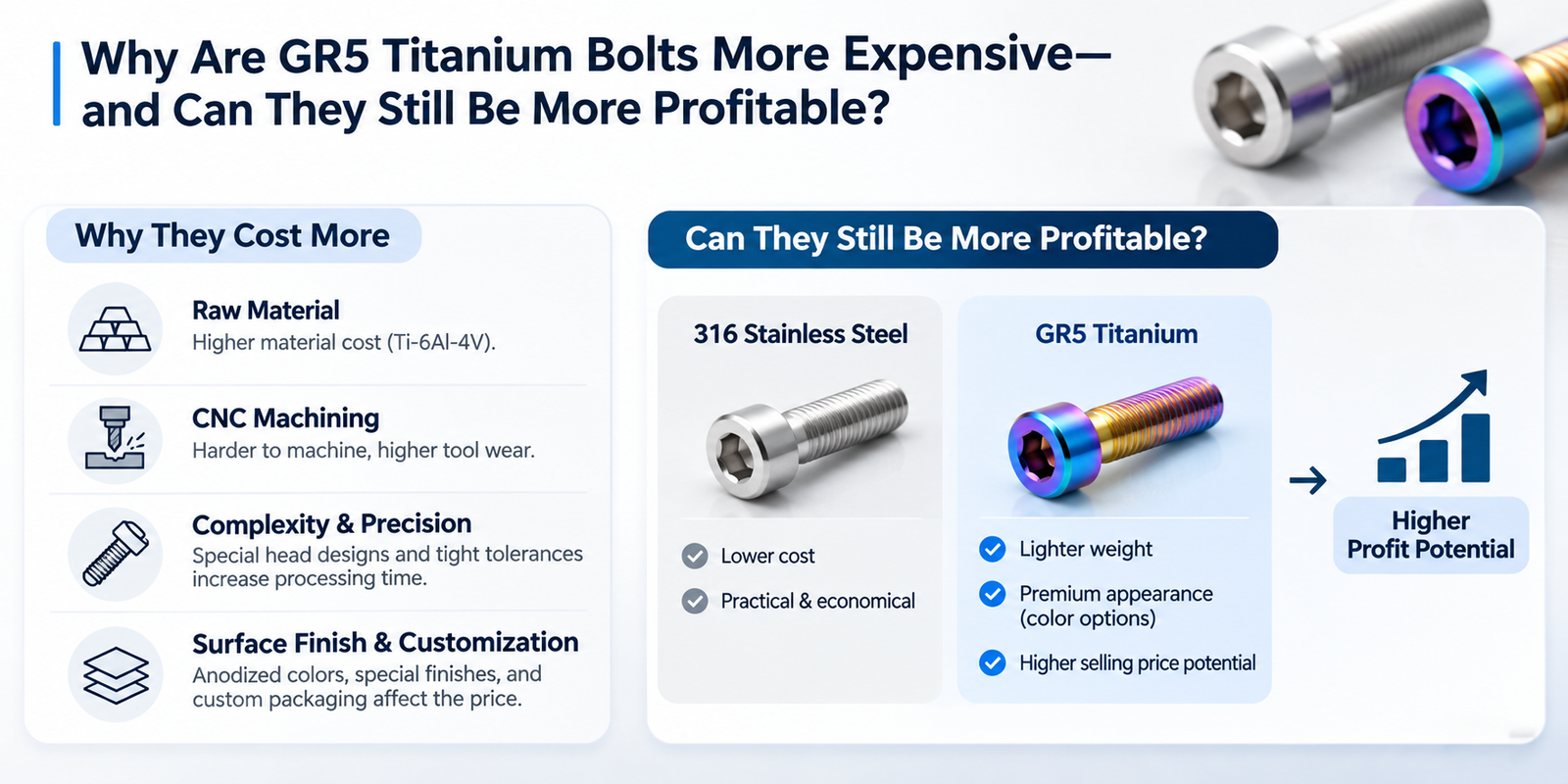
What Makes Grade 5 Titanium More Expensive to Manufacture?
From a manufacturing perspective, the cost difference comes from several factors.
Raw material cost
Ti-6Al-4V generally costs more than common stainless steel grades, partly because titanium extraction and production require specialized processing.
CNC machining requirements
Titanium’s relatively low thermal conductivity causes cutting heat to concentrate near the cutting tool.
This can increase tool wear and requires careful control of machining parameters and cooling.
Product geometry and precision
Special head designs, long threaded sections, tight dimensional tolerances, and non-standard shapes can increase machining time and inspection requirements.
Surface finishing and customization
Anodized colors, special finishes, customized packaging, and mixed-size kits can also affect the final quotation.
This is why buyers searching for gr5 titanium bolts price may find significant differences between apparently similar products.
For an accurate comparison, the material grade, dimensions, finishing requirements, quantity, and inspection scope should be the same.
Does a Higher Purchase Price Mean Lower Profit?
Not necessarily.
Consider two retail products:
Option A: 316 Stainless Steel Bolt Set
- Lower purchasing cost.
- Appeals to customers looking for practical corrosion-resistant replacements.
- May suit a more price-sensitive product range.
Option B: Customized Grade 5 Titanium Bolt Kit
- Higher purchasing cost.
- Lower weight and distinctive finishing options.
- May support premium product positioning.
A titanium kit can potentially command a higher retail price, but that only creates value if customers are willing to pay for its advantages.
For retailers and small aftermarket brands, the more useful comparison is:
Expected selling price − total landed and selling costs = expected profit per kit
Total costs should include product manufacturing, packaging, freight, duties, fulfillment, and an allowance for returns.
MOQ and inventory turnover also matter.
A higher-margin product is not necessarily the better investment if large minimum orders leave too much cash tied up in slow-moving stock.
Our manufacturing advice: Before ordering large quantities, compare a limited range of sizes and finishes that match your customers’ actual demand.
A focused, well-planned titanium bolt kit can be more practical than offering too many variations at once.
4. How to Choose a GR5 Titanium Bolt Manufacturer Supplier for Your Project
After deciding whether Grade 5 titanium is the right material, the next challenge is choosing a manufacturer that can deliver the required specifications consistently.
A reliable gr5 titanium bolt manufacturer supplier should provide more than an attractive quotation.
For buyers developing customized fasteners or replacement bolt kits, four areas deserve attention.
Material Verification
Confirm the specified titanium grade and applicable standards.
For example, Grade 5 titanium is commonly identified as Ti-6Al-4V or UNS R56400.
Where required, ask for material certificates, batch identification, and supporting inspection documents.
A raw material certificate does not automatically prove that every finished bolt meets all mechanical and dimensional requirements.
Machining and Customization Capability
A capable custom titanium fasteners manufacturer should be able to review requirements such as:
- Thread diameter, pitch, and length.
- Bolt head type and dimensions.
- Critical dimensional tolerances.
- Surface finishing and color requirements.
- Standard and non-standard specifications.
For custom orders, a drawing or physical sample is often the best starting point.
Sampling and Quality Control
Before moving into mass production, confirm how the manufacturer will inspect critical dimensions, thread fit, and surface quality.
For repeat orders, product consistency and clear identification of different specifications are especially important.
MOQ, Packaging, and Repeat Orders
A lower initial quotation may not offer better overall value if it requires an unsuitable MOQ or complicated inventory commitments.
Buyers should confirm production quantities, packaging details, lead times, and repeat-order expectations before placing an order.
At RFL Tech, we manufacture standard and customized titanium fasteners, including bolts, nuts, washers, and CNC-machined components.
With our own machining facilities, we support different dimensions, head styles, finishes, and custom specifications for motorcycle, bicycle, automotive, and other applications.
As a custom titanium fasteners manufacturer, we believe a good quotation should start with understanding the product requirements rather than simply offering the lowest unit price.
Buyers can share technical drawings, samples, or part lists to discuss manufacturing possibilities and quotation requirements.
Final Thoughts: Which Material Is Worth Your Investment?
Grade 5 titanium and 316 stainless steel are both useful fastening materials, but they serve different purchasing priorities.
For applications where practical corrosion resistance and controlled costs matter most, 316 stainless steel may be the more economical option.
For lightweight, premium, or specialized products, Grade 5 titanium may justify its higher cost.
The key is understanding the intended application, manufacturing requirements, and target market before making a purchasing decision.
When evaluating a gr5 titanium bolt manufacturer supplier, focus on material verification, dimensional accuracy, customization capability, and total purchasing value.
The better material is not always the cheaper or more expensive one. It is the one that fits your product and your customers’ expectations.


