
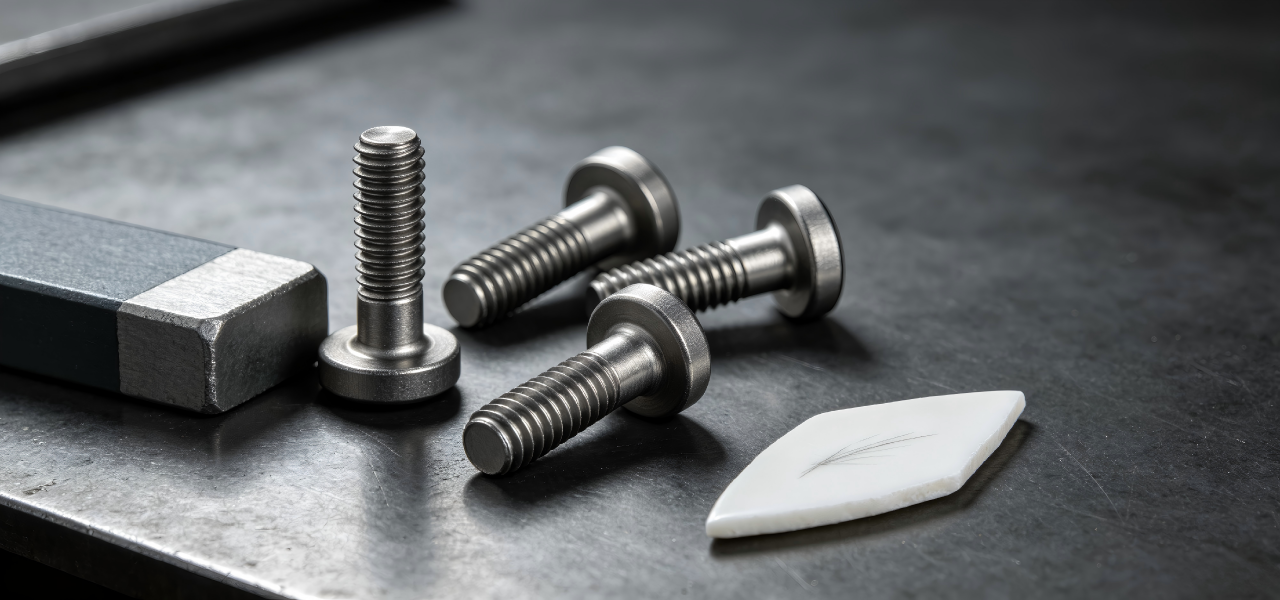
Titanium bolts are everywhere these days — bikes, cars, medical devices, you name it. But with the price tag comes a lot of fakes. People keep asking us: are titanium bolts stronger than steel? And how can you check one without sending it to a lab?
Good news — you don’t need fancy tools. Below, we walk through 6 quick checks you can do yourself — you probably already have what you need around the house.”
1. Feel the Weight — The Fastest Check
1.1 Why titanium feels different
Titanium has a density of about 4.5 g/cm³. Steel is about 7.9 g/cm³. That’s a big gap. This is also the main reason people ask are titanium bolts stronger than steel — in raw numbers, steel isn’t weak, but titanium weighs way less for similar strength.
1.2 How to do it
Take a same-size stainless steel bolt and hold it in one hand, then hold the unknown bolt in the other. If the unknown one is clearly lighter, that’s a good sign it’s titanium. It’s not as light as aluminum, but you’ll feel the difference right away.
1.3 What to expect
Titanium is about 40% lighter than steel of the same size. If the weight difference jumps out at you, you’re probably holding titanium.
2. Magnet Test — Always Do This
2.1 Titanium is not magnetic
Real titanium has no magnetic pull at all. Stick a fridge magnet next to it — nothing happens. That’s a good first sign.
2.2 If it sticks, it’s not titanium
If the magnet grabs the bolt, it’s steel or iron. No question. This test takes two seconds, so do it every time.
3. Look at the Surface Finish
3.1 What real titanium looks like
Real titanium has a cool, matte silver-gray look. It’s not shiny and chrome-like. If it’s anodized, it can be blue, purple, or gold — but the color stays deep and even, not flashy.
3.2 Fake titanium bolts
Most fakes are just steel bolts with a titanium-colored coating. They look too bright, almost chrome. After a while, the coating chips off and you see steel underneath. If it looks too shiny to be true, it probably is.
4. White Ceramic Scratch Test
4.1 What you need
Grab a white ceramic bowl or a plain white tile — something you don’t mind scratching up.
4.2 How titanium scratches
Take the bolt head and drag it gently across the white ceramic. Real titanium leaves a light gray streak that you can’t just wipe off.
4.3 How stainless steel scratches
Stainless steel basically leaves nothing behind on white ceramic. So if you see that gray mark, it’s a strong sign of titanium.
4.4 One caveat
Some hardened titanium bolts are too hard to scratch. If nothing shows up, don’t panic — just use the other tests together.
5. Tap It and Listen
5.1 The titanium sound
Give the bolt a light tap. Titanium makes a crisp, high-pitched sound that stops quickly.
5.2 The steel sound
Steel sounds duller and lower, with a longer ring. Once you’ve heard both, you can tell them apart.
5.3 Use it as a backup
This one takes some practice. Don’t rely on it alone — use it together with the magnet and weight checks.
6. Check the Price
6.1 What real titanium costs
Titanium is expensive to buy and expensive to machine. Real titanium bolts usually cost 5 to 10 times more than the same size stainless steel bolts.
6.2 Too good to be true
If someone sells you “titanium bolts” for a few cents each, they’re coated steel. No exceptions. If the price seems way too low, it probably is.
7. The 3-Step Quick Check
If you just want the short answer to are titanium bolts stronger than steel and how to spot real titanium bolts, here’s all you need to remember:
Step 1: Magnet doesn’t stick
Bring a magnet close. If nothing happens, it passes the first test.
Step 2: Way lighter than steel
Compare it to a same-size steel bolt. The clear weight difference tells you a lot.
Step 3: Leaves a gray mark on ceramic
Scratch it on white ceramic. A light gray streak means it’s very likely titanium.
Hit all three points? You’re looking at real titanium. Hope these tips help you avoid the fakes and pick good titanium bolts for your projects.


